The Bridge over the River Kwai, Kanchanaburi
The surviving steel bridge on the Burma Railway, built by prisoners of war and forced labourers in 1943.
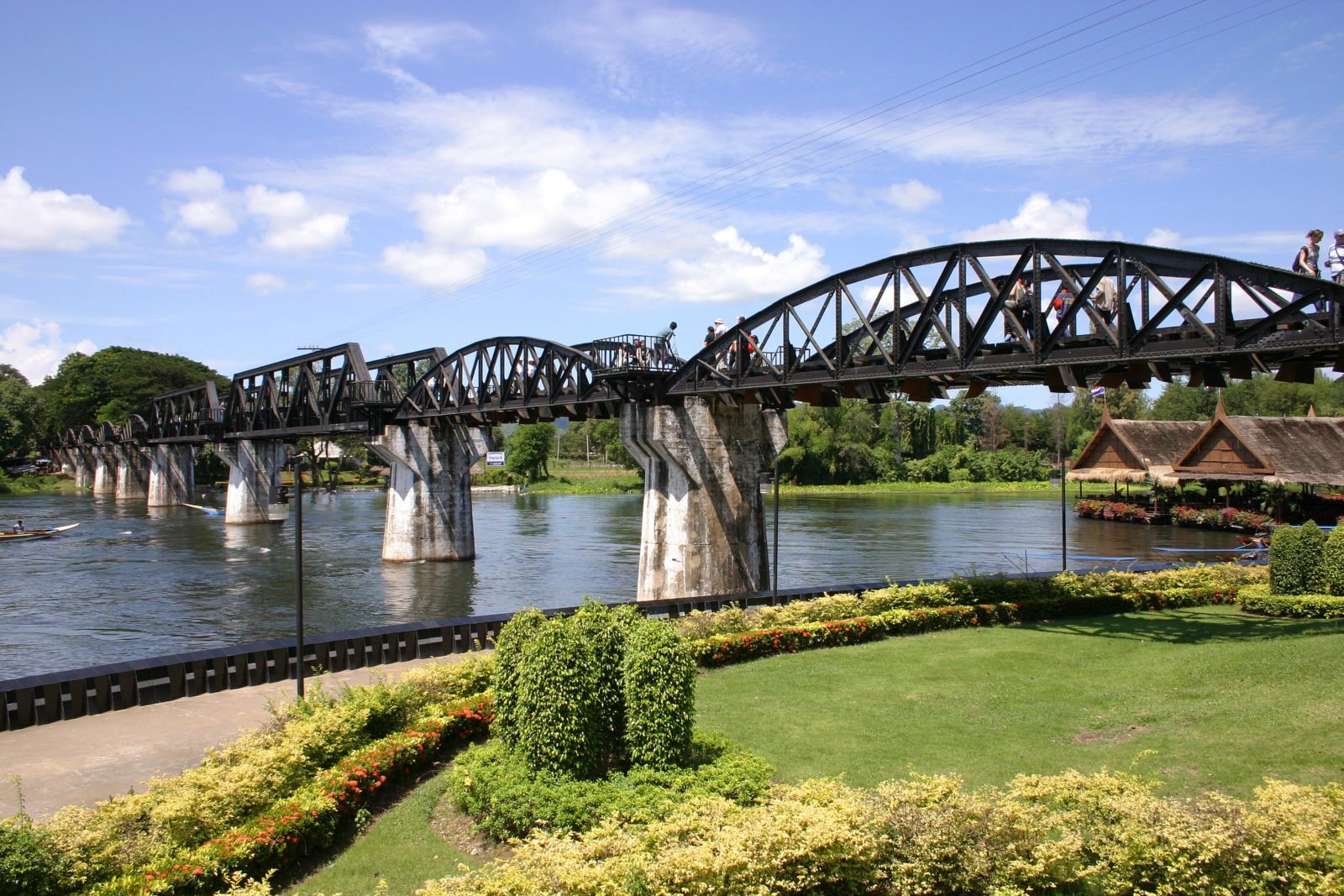
The Bridge over the River Kwai, Kanchanaburi
The bridge over the Khwae Yai carries the Burma Railway across the river at the northern edge of Kanchanaburi town. It was built in 1943 by Allied prisoners of war and by far larger numbers of conscripted Asian labourers, under the Japanese occupation, as part of a line driven through to Burma at enormous cost in lives.
The bridge standing today is largely original. Its curved steel spans were shipped from Java; the two angular spans in the centre are post-war replacements for sections destroyed by Allied bombing in 1945. Visitors can walk the deck between refuge platforms, and trains still cross it on the working line to Nam Tok.
The novel and the 1957 film made the name famous and got most of the details wrong, including the river - the crossing here is the Khwae Yai, and the waterway the story describes was a different one. The war cemeteries and the museums explaining the railway are in the town a short distance south.
- Thailand-Burma Railway Centre — The Thailand-Burma Railway Centre in Kanchanaburi tells the story of the Death Railway through exhibits and research, next...
- Erawan National Park, Kanchanaburi — Erawan National Park, Kanchanaburi: An Overview Erawan National Park in Kanchanaburi is home to the best-known waterfall...
- Wat Tham Sua, Kanchanaburi — A hilltop temple above the Mae Klong paddy fields, with a huge seated Buddha and a Chinese-style pagoda alongside.
- Hellfire Pass Memorial, Kanchanaburi — The deepest cutting on the Burma Railway, hacked through rock by hand, and the memorial museum above it.
- Kanchanaburi War Cemetery (Don Rak) — The main Allied cemetery of the Burma Railway, holding nearly seven thousand graves in the centre of Kanchanaburi.
- Sai Yok Noi Waterfall, Kanchanaburi — A wide limestone cascade beside the Death Railway terminus at Nam Tok.