Angkor Wat, Siem Reap
The largest religious monument in the world, built in the twelfth century and never abandoned since.
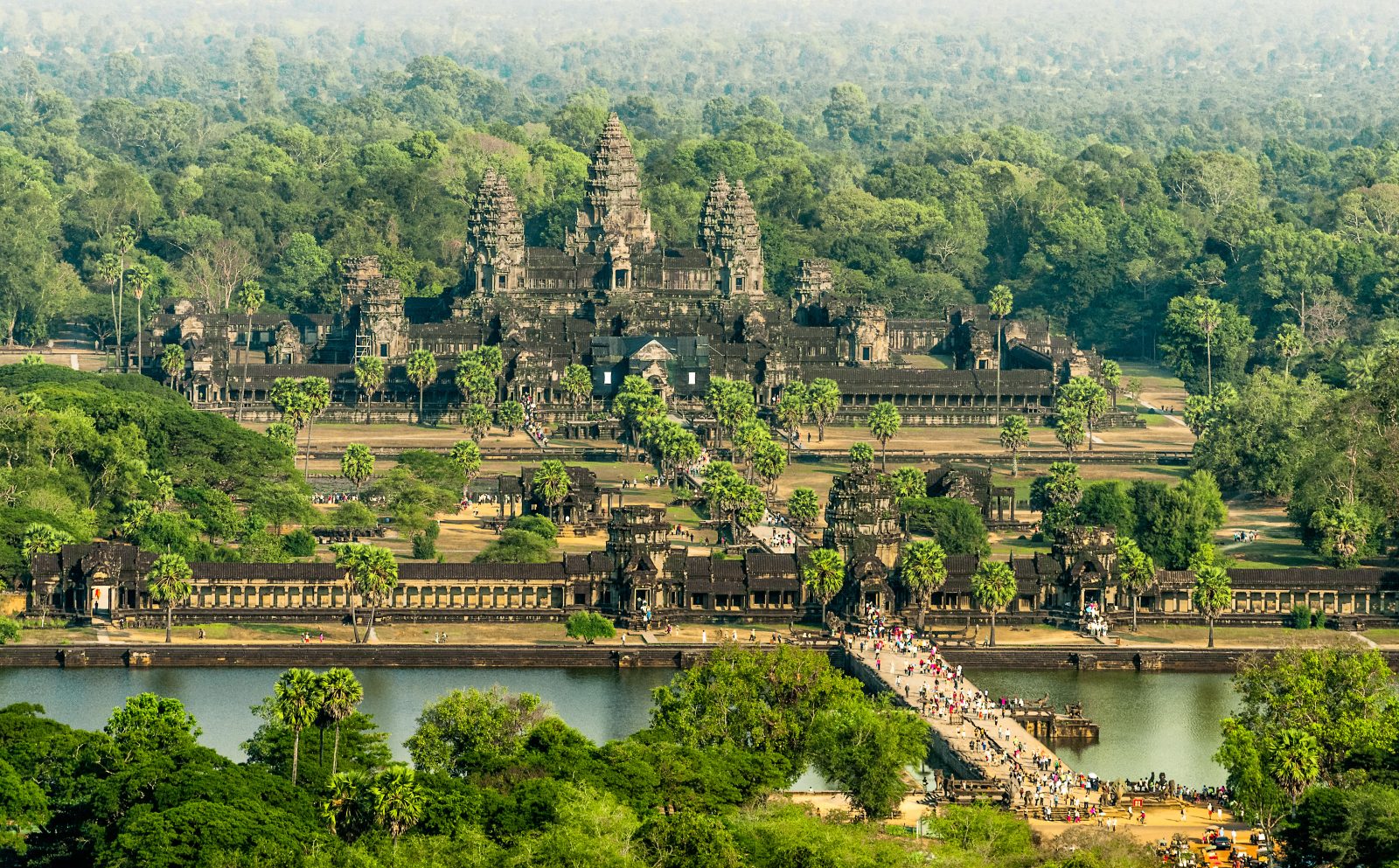
Angkor Wat, Siem Reap
Angkor Wat was built in the first half of the twelfth century for Suryavarman II as a temple to Vishnu, and later became a Buddhist monastery - which is why, unlike most of Angkor, it was never abandoned and never wholly reclaimed by forest. It is the largest religious structure in the world by area, and it appears on the Cambodian flag.
The temple is a model of the Hindu cosmos: a moat standing for the ocean, a walled enclosure for the mountains at the world's edge, and five towers for the peaks of Mount Meru. The scale registers slowly - a causeway of nearly half a kilometre crosses the moat before the outer gallery is even reached. That gallery carries eight hundred metres of continuous bas-relief, including the Churning of the Sea of Milk and a procession of Suryavarman's army, all of it carved in the twelfth century.
Angkor Wat faces west, unusually, so the classic view is at sunrise from across the reflecting pools. It is one temple within the much larger Angkor Archaeological Park, north of Siem Reap town.
- Angkor National Museum, Siem Reap — The museum that explains the Khmer empire, best visited before the temples rather than after.
- Banteay Srei, Siem Reap — A small tenth-century temple in pink sandstone, carved more finely than anything else at Angkor.
- Preah Khan, Angkor — A vast, half-collapsed monastic city north of Angkor Thom, quieter than any temple of its size.
- Ta Prohm, Angkor — The temple left in the grip of the forest, where silk-cotton roots grow through the masonry.
- The Bayon, Angkor Thom — The temple of two hundred serene stone faces at the exact centre of the walled city of Angkor Thom.
- Kampong Phluk, Tonle Sap — A stilt village on the Tonle Sap where the houses stand six metres above the dry-season ground.