Ta Prohm, Angkor
The temple left in the grip of the forest, where silk-cotton roots grow through the masonry.
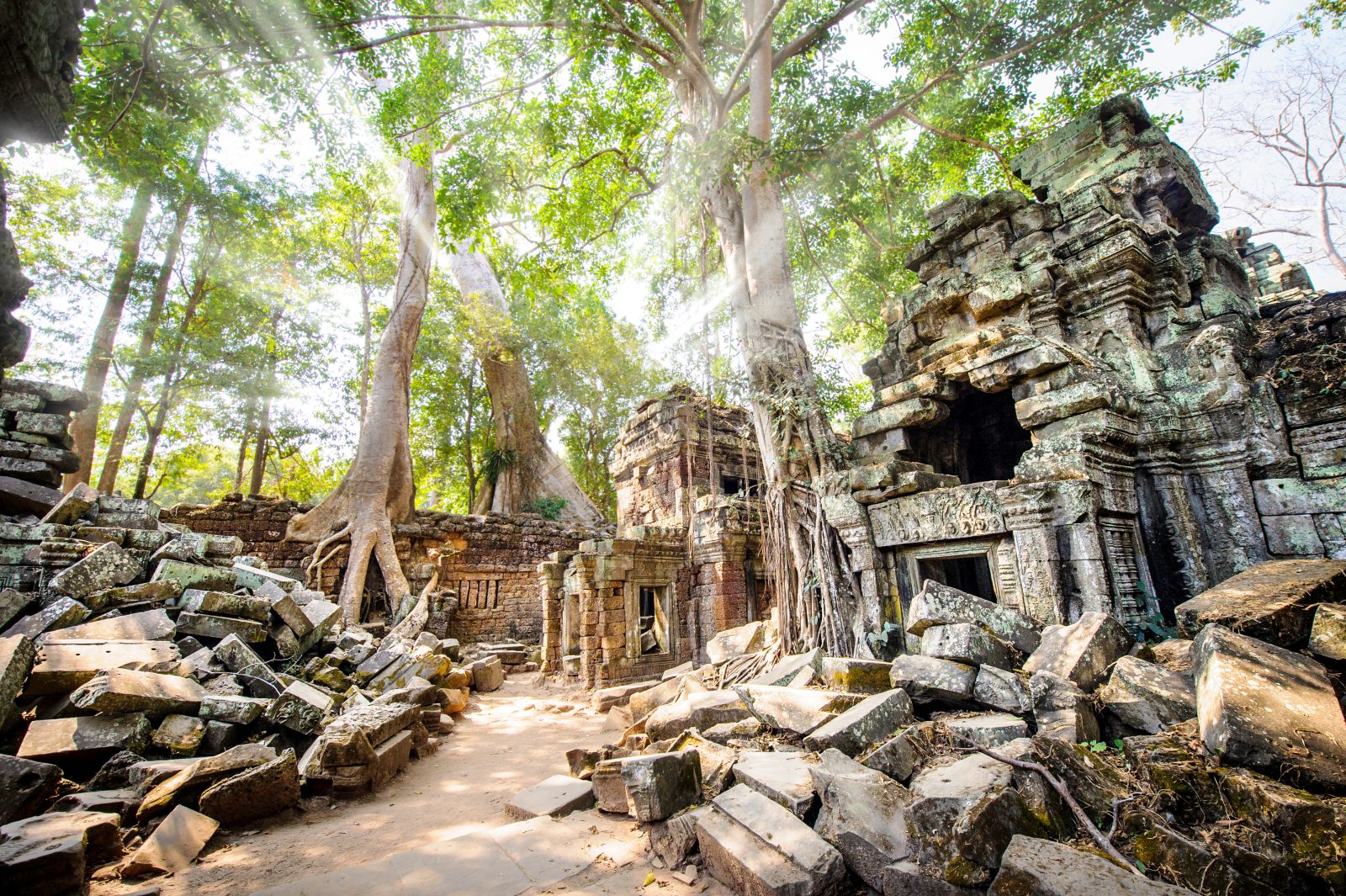
Ta Prohm, Angkor
Ta Prohm was built at the end of the twelfth century by Jayavarman VII as a Buddhist monastery and university, and a surviving inscription records the scale of it: many thousands of people attached to the temple, and a treasury that included a set of gold dishes and a great quantity of pearls.
It is famous for what was done to it afterwards, which is nothing. When Angkor was cleared in the twentieth century, Ta Prohm was deliberately left much as it was found, so the silk-cotton and strangler fig roots that grew down through the galleries are still there, gripping the stone, holding some walls up and pulling others apart. Selective work now keeps it stable without tidying it.
The result is the temple that best conveys how all of Angkor looked to the first European visitors. It lies east of Angkor Thom and is usually visited between the Bayon and Angkor Wat.
- Angkor National Museum, Siem Reap — The museum that explains the Khmer empire, best visited before the temples rather than after.
- Angkor Wat, Siem Reap — The largest religious monument in the world, built in the twelfth century and never abandoned since.
- Banteay Srei, Siem Reap — A small tenth-century temple in pink sandstone, carved more finely than anything else at Angkor.
- Preah Khan, Angkor — A vast, half-collapsed monastic city north of Angkor Thom, quieter than any temple of its size.
- The Bayon, Angkor Thom — The temple of two hundred serene stone faces at the exact centre of the walled city of Angkor Thom.
- Kampong Phluk, Tonle Sap — A stilt village on the Tonle Sap where the houses stand six metres above the dry-season ground.