The Bayon, Angkor Thom
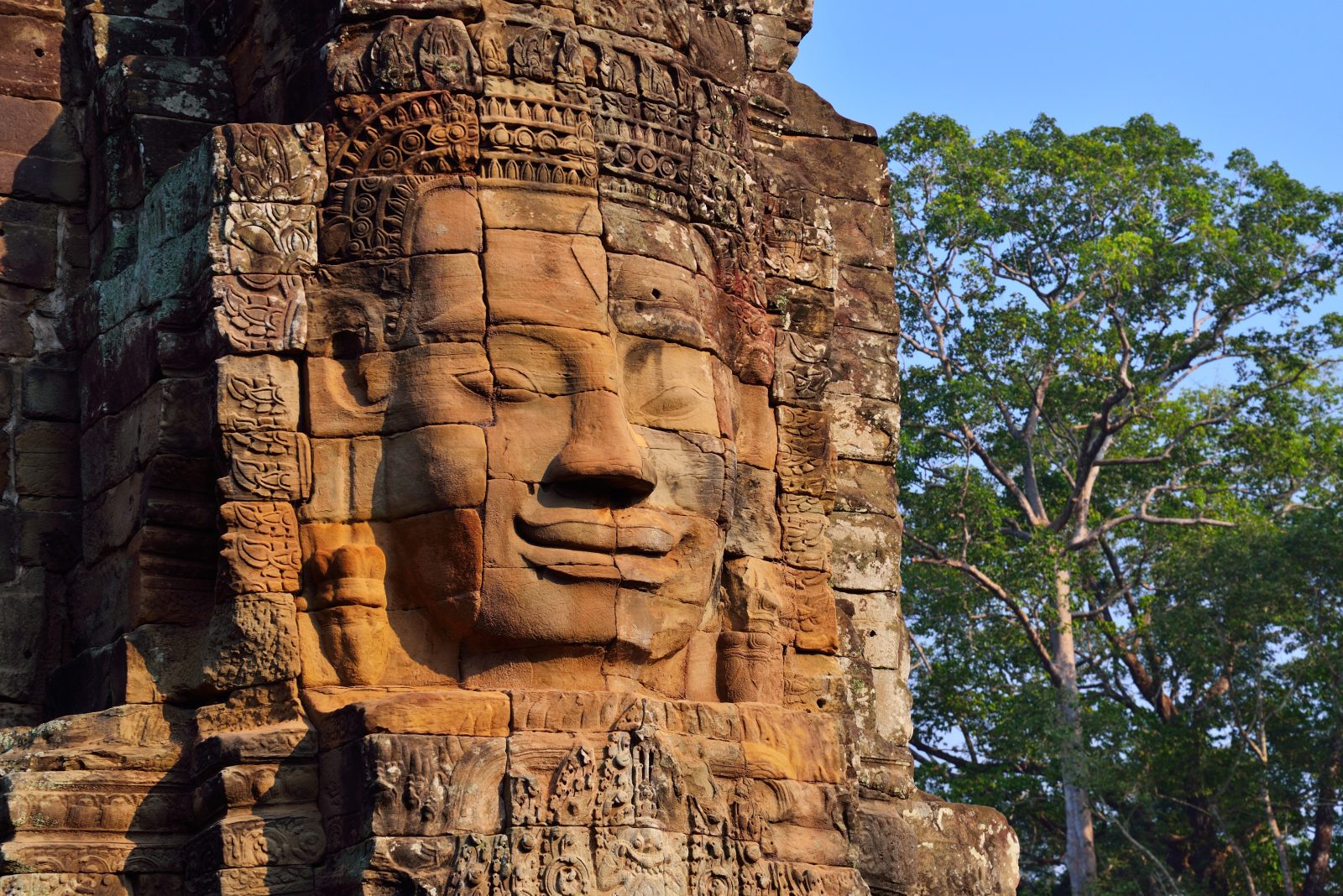
The temple of two hundred serene stone faces at the exact centre of the walled city of Angkor Thom.
The Bayon, Angkor Thom
The Bayon stands at the precise centre of Angkor Thom, the walled capital built by Jayavarman VII at the end of the twelfth century. It is the last great temple raised at Angkor and the strangest: a dense, compact mass of towers rather than a spreading plan.
What makes it unmistakable are the faces - more than two hundred of them, carved four to a tower, each several metres high, gazing out over the four cardinal directions with the same faint smile. Whether they represent the bodhisattva Avalokiteshvara, the king himself, or both deliberately, is still argued. Moving through the upper terrace means passing them continuously at close range, which is the experience people remember.
The outer galleries carry bas-reliefs quite unlike Angkor Wat's mythological scenes: these show ordinary twelfth-century life - markets, cockfights, cooking, a naval battle against the Chams - and are among the best records of the period anywhere.
- Angkor National Museum, Siem Reap — The museum that explains the Khmer empire, best visited before the temples rather than after.
- Angkor Wat, Siem Reap — The largest religious monument in the world, built in the twelfth century and never abandoned since.
- Banteay Srei, Siem Reap — A small tenth-century temple in pink sandstone, carved more finely than anything else at Angkor.
- Preah Khan, Angkor — A vast, half-collapsed monastic city north of Angkor Thom, quieter than any temple of its size.
- Ta Prohm, Angkor — The temple left in the grip of the forest, where silk-cotton roots grow through the masonry.
- Kampong Phluk, Tonle Sap — A stilt village on the Tonle Sap where the houses stand six metres above the dry-season ground.