Banteay Srei, Siem Reap
A small tenth-century temple in pink sandstone, carved more finely than anything else at Angkor.
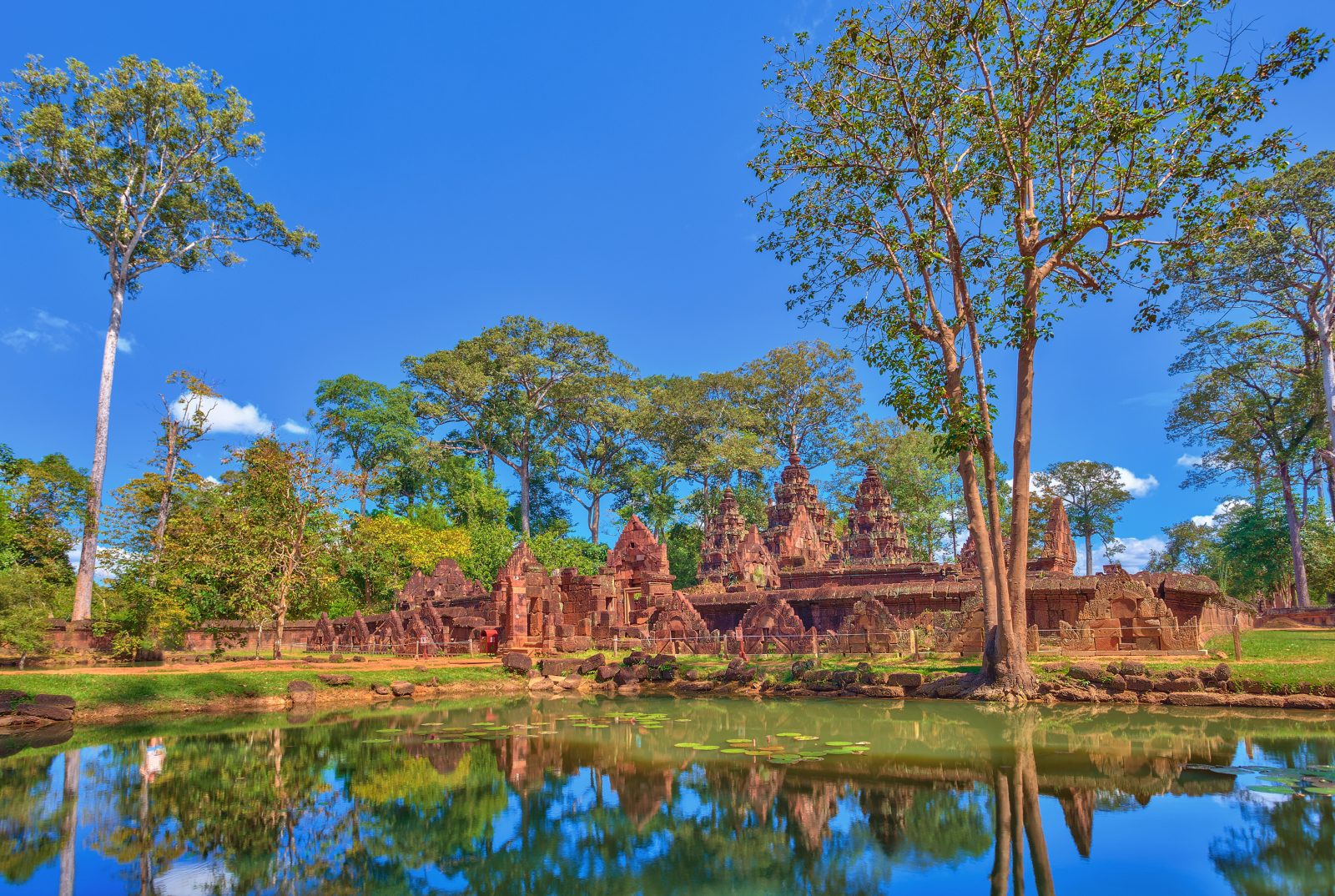
Banteay Srei, Siem Reap
Banteay Srei stands about twenty-five kilometres north-east of the main Angkor group and is unlike the rest of it in almost every way. It was consecrated in 967, two centuries before Angkor Wat, and was built not by a king but by a Brahmin who was tutor to one.
It is small - the doorways are barely more than human height - and built from a hard pink sandstone that takes detail no other stone at Angkor will hold. The carving is consequently the finest in Cambodia: deep, crisp, almost undercut, covering pediments and lintels with scenes from the Ramayana and with the female figures, devatas, that gave the temple its modern name, the citadel of women.
Because the reliefs are the point, it repays a slow visit in low light. The road out passes through farmland and villages, so it is usually combined with the Kbal Spean river carvings further on.
- Angkor National Museum, Siem Reap — The museum that explains the Khmer empire, best visited before the temples rather than after.
- Angkor Wat, Siem Reap — The largest religious monument in the world, built in the twelfth century and never abandoned since.
- Preah Khan, Angkor — A vast, half-collapsed monastic city north of Angkor Thom, quieter than any temple of its size.
- Ta Prohm, Angkor — The temple left in the grip of the forest, where silk-cotton roots grow through the masonry.
- The Bayon, Angkor Thom — The temple of two hundred serene stone faces at the exact centre of the walled city of Angkor Thom.
- Kampong Phluk, Tonle Sap — A stilt village on the Tonle Sap where the houses stand six metres above the dry-season ground.